



Exploring the role of language in influencing decisions.
Emotions drive many of our decisions throughout the day, from choosing what to eat for lunch, to what we say to colleagues and strangers, to what we watch in the evening. Our emotional engagement drives us to act, make decisions, and spread messages to each other.
Appealing to the emotions of a reader is therefore a powerful tactic in writing, from novelists wrapping readers up in a good story, to marketers engaging potential customers in their product or service.
In this guide, we’ll be looking at emotional marketing, at words specifically used to trigger an emotional response in a reader, whether that’s by scaring them, making them happy, or making them angry. We’ll look through some examples of emotional words, and explore how they can be used to make compelling copy that gets a response.
What are emotional words in marketing?
Emotional words are terms designed to trigger a psychological response such as excitement, fear, trust or urgency. In marketing and copywriting, they are used to increase attention, improve message recall and influence decision-making.
Emotive language is used throughout everyday speech, for telling stories, trying to convince others to see your point of view, or trying to encourage someone. So employing them in marketing stands to reason
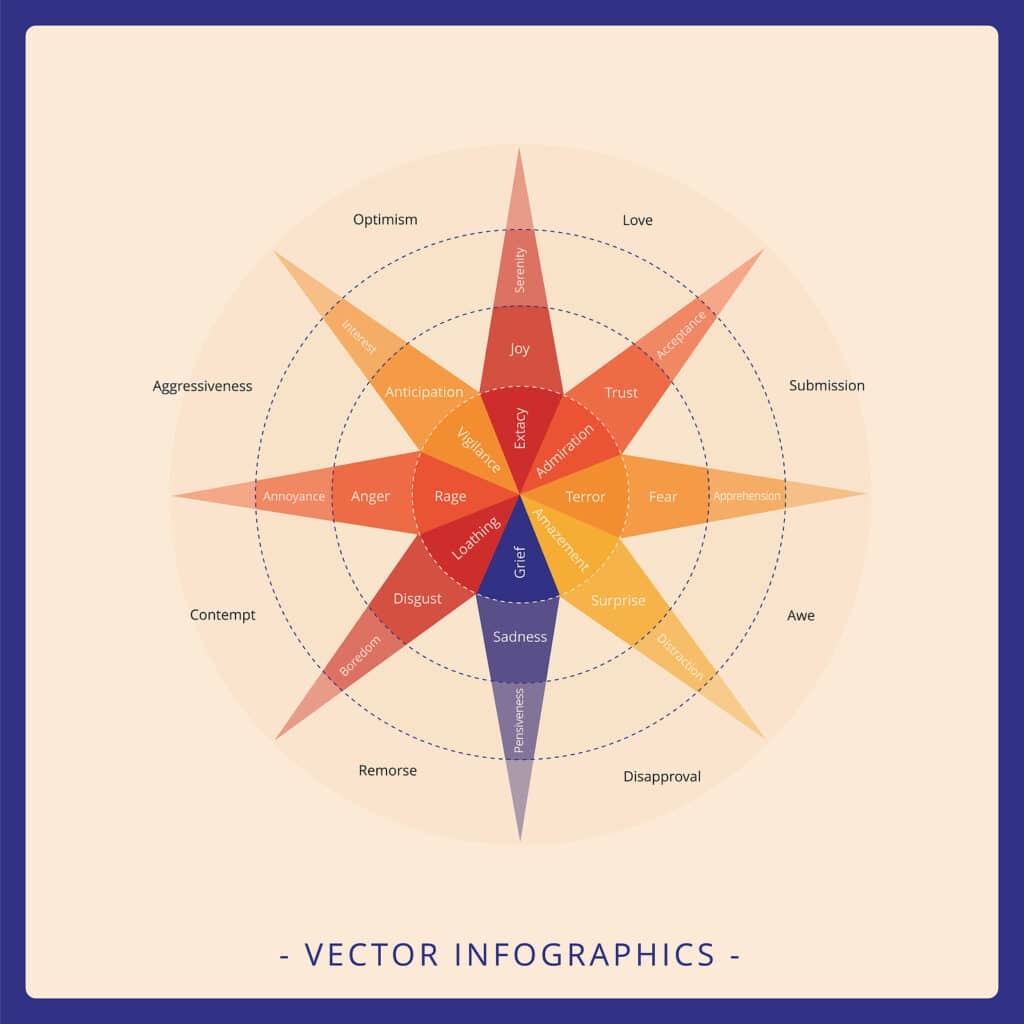
There have been many different attempts to categorise emotions over the years, with the example below taken from psychologist Robert Plutchik.
Why does emotional marketing work?
Psychological research consistently shows that emotion plays a central role in decision-making. Studies in behavioural economics have demonstrated that people rarely make purely rational choices. Instead, emotional responses influence attention, memory and purchasing behaviour.
For example, neuroscientist Antonio Damasio’s work on decision-making found that people with impaired emotional processing struggled to make even simple choices, highlighting how emotion underpins judgement and action.
Marketing research supports this pattern. Long-term analysis from the Institute of Practitioners in Advertising (IPA) found that campaigns built primarily around emotional messaging were significantly more effective at driving business results than purely rational campaigns. In particular, emotional campaigns were far more likely to produce strong long-term profitability and brand growth.
Together, this research helps explain why emotional language remains such a powerful tool in marketing. When a brand’s tone of voice and messaging strategy connects with how people feel, rather than just what they think, it is more likely to capture attention, stay memorable and influence behaviour.
How are emotional words used in marketing?
All writing can benefit from the use of emotional words, whether that’s engaging the readers of a novel in the world of the characters, engaging someone in an opinion through a compelling essay, or triggering a powerful emotional response through advertising.
Let’s look at some examples of emotional words in copy:
Example 1: fiction.
Here is a fiction extract with no emotional words:
“John walked over to the window, touching the glass with his hand. He looked out over the city skyline.”
While it has a certain minimalist flair, it leaves the reader with little insight or engagement. Here’s a similar extract that has been rewritten to prioritise emotional words:
“John was incensed, collapsing towards the window. Panicked, he steadied himself with his hand, hyperventilating as he looked out over the dark city”
Overselling it a little, but suddenly you have an idea about John, the sort of person he is and why he’s behaving like this. Emotional language can help you to bond with characters, hate villains, and generally invest in the story as a reader. People often talk of disappearing into books, of finding themselves transported away, and emotional words are an important part of this process.
We can easily transfer this idea into copywriting, using vivid language to paint a picture of a product or service and the feeling it gives thew end user to more effectively hook the reader.
Example 2: non-fiction.
Here is an example of how a non-fiction text can sound without emotional words:
“The markets closed today at their lowest ever total”
And here’s the same sentence that has been rewritten to include some more emotional language:
“Catastrophic collapse as markets plunge to devastating historic low”
While communicating the same basic message, you can use emotional words to cause anxiety and sadness, engaging a reader within a story. This can be used within a tabloid newspaper, a historical non-fiction book, an essay arguing for a certain point of view, and many other forms.
How do you successfully target emotions in copywriting?
While marketing can target any emotion, you’ll ultimately be looking for an actional response from a consumer. Emotional marketing can drive a variety of responses, whether that is buying a product, paying for a service, or engaging with a concept or political movement. Emotional words can also enhance the use of power words.
In this section, we’ll look at the four basic emotions targeted through feeling words, though obviously there is a more complex list of feelings that can be targeted, such as lust, envy, guilt, and others.
Happiness.
Probably one of the key emotional targets in marketing is happiness, or related emotions like excitement, desire, or anticipation. For example. words like “beautiful”, “thrilling”, “awe-inspiring”, “delicious”, and “comforting” are used to elicit a positive emotional response. This can be used for products like food, clothing, cars, and many more. It can also be used for services like holidays, museums, or teeth whitening.
You can even use emotional marketing to convince a target audience to engage in ideas through happy emotional words, such as Obama’s all-conquering “Hope”, or for a slightly more obscure example Huey Long’s promise to make “Every man a king”. Both of these are designed to stir up an emotional response in a reader, to engage them through positive emotions in the promise of a brighter future.
Sadness.
Sadness can be a valuable emotion within the marketing of companies like charities. Sadness can make us connect with people across the world, showing empathy. Charities will use emotional words like “desperate”, “miserable”, “destitute”, and “scared” in their marketing copy, to help engage those who read it, making them more likely to donate money.
Larger companies can connect sadness about an issue to positive actions caused by their business, as in “the rainforests have been devastated by greedy industrialists, which is why we’re happy to only use sustainably sourced wood in our products”. Evoking sadness about a topic before showing yourself as the solution can be an effective strategy.
Anger.
Anger can be a great way to get a click, but isn’t always the most sustainable way to get positive engagement in your product. Like sadness, it can be an effective way to engage people in a charity, by making them angry about the cause the charity is working against. Anger is often used in political advertising, with emotional language like “disgusting”, “outrageous”, “libellous”, and “reprehensible” used to encourage people to take a stand against a candidate, industry, or issue by voting for a specific candidate.
Fear.
Using emotional words to inspire fear in your readers can be a great way to market certain products, services, and ideas. Fear can be used to sell safety or security products, with emotional words like “danger”, “risk”, “devastation”, or “uncertain” making readers afraid of the consequences should they not make a purchase. It can also create a sense of urgency, by implying limited time to buy a product or service. Fear is often used for government schemes, such as anti-smoking advertising or safe driving advertising. Emotional marketing can also be used for political campaigning, to try and make readers afraid about a topic or candidate.
How to use fear effectively and ethically in direct response copy.
Emotional words cheat sheet for copywriting.
Marketers often group emotional language around a few core feelings. Each can be used to guide how audiences respond to messaging, from building excitement to creating urgency or empathy.
Quick summary: Emotional words help marketers trigger specific feelings such as happiness, fear, anger or empathy, encouraging audiences to pay attention, remember a message or take action.
| Emotion | Example words | How marketers use this emotion |
|---|---|---|
| Happiness/Positive emotion | Comfortable, Delightful, Encouraging, Exhilarating, Funny, Joyful, Joyous, Lighthearted, Serene, Thrilling, Uplifting, Radiant, Inviting, Refreshing, Reassuring, Inspiring, Vibrant, Delicious, Magical, Enchanting, Rewarding, Comforting, Brilliant, Captivating, Heartwarming | Used to create positive associations with a product or brand. Common in lifestyle, travel and retail marketing where the goal is to link a purchase with enjoyment or personal satisfaction. |
| Sadness/Empathy | Heartbreaking, Disappointing, Mournful, Depressing, Tearjerking, Heartwrenching, Sombre, Bleak, Wistful, Gloomy, Devastating, Tragic, Lonely, Powerless, Abandoned, Hopeless, Grief-stricken, Shattered, Forgotten, Broken, Despairing, Heavy-hearted, Sorrowful, Melancholic, Tearful | Often used by charities and awareness campaigns to build empathy and encourage supportive action such as donations or advocacy. |
| Anger/Outrage | Disgusting, Evil, Wretched, Awful, Unfair, Disproportionate, Reckless, Hedonistic, Contemptible, Atrocious, Outrageous, Infuriating, Shocking, Corrupt, Unacceptable, Exploitative, Greedy, Cruel, Disgraceful, Deceptive, Fraudulent, Unjust, Scandalous, Unforgivable | Can be used to highlight injustice or challenge a problem an organisation aims to solve. This approach appears frequently in activism, advocacy campaigns and investigative journalism. |
| Fear/Anxiety | Terrifying, Demonic, Aberrant, Preying, Alarming, Apocalyptic, Menacing, Nightmarish, Overwhelming, Embarrassing, Dangerous, Urgent, Critical, Threatening, Disturbing, Uncertain, Vulnerable, Panic-inducing, Risky, Exposed, Fragile, Unstable, Precarious, Dire, Grim | Creates urgency by emphasising risks or negative consequences. Common in safety messaging, insurance marketing and public health campaigns. |
Are emotional words good for SEO?
Emotional language can improve click-through rates in headlines and meta descriptions by making content more compelling in search results. However, search performance still depends on relevance, authority and genuinely useful content rather than persuasive wording alone.
At Bamboo Nine, our skilled team of SEO copywriters (hello), use emotional language carefully within SEO copywriting, particularly in calls to action and key messaging. More importantly, we align that language with each client’s tone of voice, audience expectations and search intent, ensuring content remains credible, useful and optimised for long-term organic visibility.
Learn more about our full-service organic marketing.
Turn emotional marketing into measurable results.
Emotional language can improve engagement, but it’s only effective when it fits a broader content strategy. Brands need a clear understanding of audience behaviour, search intent and tone of voice before applying emotional triggers in their messaging.
This is where structured analysis helps.
Our Discovery Consultation starts by auditing your current marketing performance to understand what is working, what is not, and where the opportunities for growth lie. From there, we develop a strategy that aligns your content, SEO and messaging around measurable outcomes.
If you want your marketing to resonate more effectively, the sensible place to start is with a clear view of your current performance.
Just get in touch with our team for a quick, no-obligation chat to see how we could help you influence your customers.