



Why ecommerce brands need to be strategic about their customer base.
When ecommerce brands come to our marketing agency, we often find that their existing digital strategy no longer reflects how their customers actually behave.
We see this regularly during Discovery Consultations. A brand invests heavily in channels because maybe competitors are using them, or someone internally feels the business “should” have a presence there. Maybe another agency recommended it a while back.
Meanwhile, the channels that ecommerce customers genuinely use during the buying process receive less attention and inconsistent optimisation.
An effective ecommerce digital marketing strategy starts with a simpler question: Where are your customers already paying attention, and what helps them move closer to purchase?
That question shapes everything else, from your ecommerce SEO strategy and content marketing to your paid advertising spend, social media strategy, customer retention planning, and website experience.
Ecommerce customer journeys are fragmented.
The idea of a neat linear funnel has never reflected reality particularly well, especially in ecommerce.
Customers move between devices, platforms, creators, search engines, marketplaces, reviews, email, WhatsApp groups, Reddit threads and TikTok comments before buying a product or service.
Some discover brands socially and convert through search. Others search first, leave, then return weeks later through paid social. Existing customers may skip most of the funnel entirely because trust already exists.
Your ecommerce customer journey is shaped by behaviour patterns, not by the internal structure of your marketing team. It’s an important distinction to make commercially, because when channels operate independently of each other without considering the reality of fragmented journeys, you waste spend.
As an experienced ecommerce digital marketing agency, we regularly see ecommerce brands investing in paid social campaigns that drive users toward weak product pages, while SEO teams focus on traffic growth without considering conversion intent. Email flows often exist separately from wider customer loyalty planning. Organic social content may build engagement without supporting measurable commercial outcomes.
The result is activity without cohesion.
The ecommerce customer journey does not end at conversion.
A surprising number of ecommerce strategies still focus almost entirely on acquisition. Retention usually receives attention later, once growth becomes more expensive.
But not focusing on ecommerce customer retention actually creates avoidable pressure, because existing customers often generate the most profitable revenue over time.
Strong ecommerce customer journey stages include post-purchase experience, customer service quality, email communication, loyalty strategy and repeat engagement planning.
Brands that improve ecommerce customer journey performance after purchase often see stronger long-term returns from every acquisition channel because retention improves total customer value.
That affects paid efficiency, organic growth, and profitability simultaneously.
Customer expectations have changed.
Ecommerce customers now expect:
- faster responses
- consistent communication
- transparent delivery information
- frictionless mobile experiences
- clear product information
- relevant recommendations
Poor post-purchase experiences now affect acquisition indirectly because customer reviews, social commentary, and brand sentiment influence future buying decisions much faster than before.
The ecommerce customer journey has become increasingly interconnected.
What is an ecommerce customer journey map?
An effective ecommerce customer journey map is one way to ensure your marketing meets the customer where it needs to.
It can help teams understand:
- how customers interact with the brand
- which touchpoints influence purchase decisions
- where friction appears during the checkout process
- which channels contribute to customer retention
- how customer behaviour changes between acquisition and repeat purchase
Without this visibility, brands often under-invest in the areas that genuinely influence conversion rates.
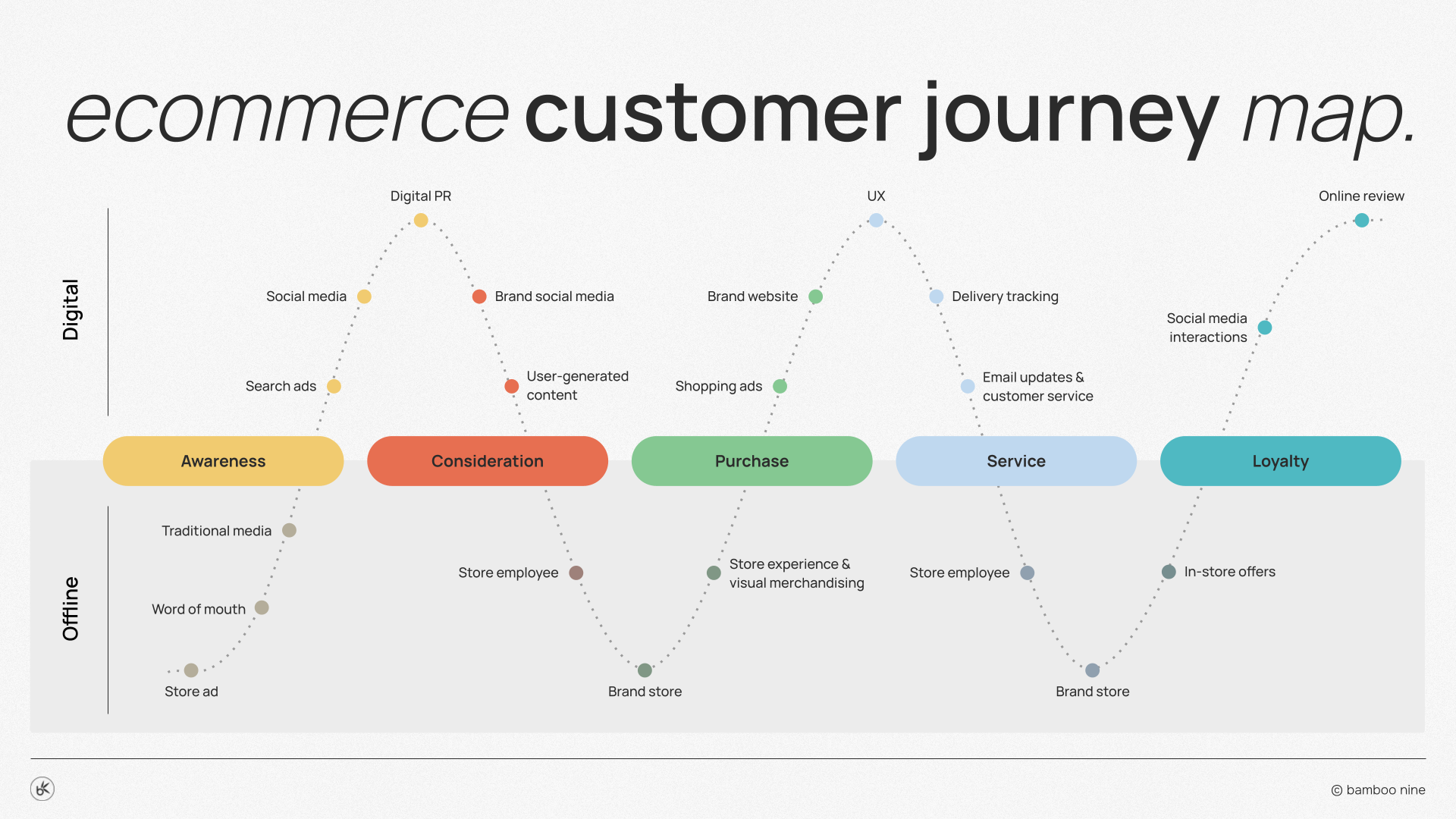
An example of a customer journey map for ecommerce users, with multiple touchpoints demonstrated from awareness to loyalty.
What digital channels are most important for ecommerce marketing?
Ecommerce brands do not need to be on every social platform.
This tends to be unpopular advice in marketing meetings.
A growing ecommerce brand does not automatically need TikTok, LinkedIn, Pinterest, Instagram, YouTube Shorts, Meta ads, influencer marketing, affiliate campaigns and a reactive content calendar running simultaneously.
Different channels support different buying behaviours. Some products suit visual discovery. Others depend heavily on search intent, comparison research, or repeat purchase behaviour.
A luxury interiors brand may see stronger commercial returns from Pinterest, SEO and long-form inspiration content than from TikTok trends. A supplements brand might depend heavily on creator-led paid social and retention email flows. A B2B ecommerce manufacturer may find LinkedIn and organic search outperform broader social media activity entirely.
What’s the best ecommerce social media strategy?
This question depends on audience behaviour. You need to take into account buying consideration, product margins, competition, and operational capacity for a start.
Many ecommerce brands struggle because their teams are stretched across channels that add little strategic value. Content quality drops when volume is prioritised more, having a knock-on effect on customer service teams, who have to deal with inconsistent messaging (a defined tone of voice is vital to avoid this). Paid media budgets become harder to justify internally because attribution is unclear.
So, social media strategies for ecommerce brands that work usually look more focused than people expect. They prioritise the platforms that align with the audience and support the wider ecommerce customer journey stages rather than chasing visibility everywhere at once.
Our organic marketing experts for ecommerce can help you decide what’s right for your business – just get in touch for a chat and we’ll be able to point you in the right direction.
An ecommerce SEO strategy should reflect commercial intent.
An ecommerce SEO strategy should support revenue generation, not just traffic acquisition.
That sounds obvious, although many SEO strategies still focus heavily on rankings without considering what happens after the click.
A strong SEO strategy for ecommerce websites considers:
- how users search at different buying stages
- whether category and product pages match intent
- where customers abandon journeys
- how technical performance affects conversion
- whether informational content supports commercial discovery
- how AI search and GEO plays into it all
For example, informational content often plays a bigger role in ecommerce customer journey touchpoints than brands realise.
Searches around sizing, comparisons, materials, maintenance, compatibility, delivery expectations or use cases frequently sit between awareness and purchase. eCommerce brands that answer those questions clearly often improve conversion rates because they reduce uncertainty before checkout.
We’ve also seen ecommerce sites invest heavily in broad traffic-driving keywords while neglecting high-intent product or category searches that generate significantly stronger returns. This is where content strategy understanding pays dividends.
What’s the best SEO strategy for an ecommerce site?
The best SEO strategy for an ecommerce website usually combines technical SEO, content structure, commercial intent mapping and CRO thinking rather than treating SEO as a standalone acquisition channel.
That becomes even more important for larger catalogues.
For a high-volume ecommerce site, your SEO strategy will require stronger prioritisation because resource allocation is so important. Optimising every category equally rarely makes commercial sense. Teams need clarity around margin, competition, search demand, conversion performance and operational constraints before deciding where effort should go.
This is where a comprehensive understanding of marketing strategy matters more than channel execution. At Bamboo Nine, we can’t give you a one-size-fits-all ecommerce marketing solution because that wouldn’t be honest. If you’re looking for advice on ecommerce SEO strategy, get in touch with our team for a no-obligation chat.
Paid advertising for ecommerce cannot fix structural problems.
Paid media often becomes the pressure valve for ecommerce performance issues. Organic visibility is slow, so budgets shift into Meta or Google Ads. Conversion rates soften, so spend increases to compensate for declining efficiency.
Teams push to scale acquisition before fixing deeper experience problems — and eventually, CAC rises and reporting becomes harder to defend. Naturally, confidence in the strategy starts to erode internally.
Paid advertising for ecommerce brands works best when the foundations are already stable. You need:
- accurate tracking and attribution
- clear positioning
- fast-loading product pages
- credible social proof
- coherent landing experiences
- consistent messaging across channels
- Without those in place, spend tends to increase faster than profitability.
We see this regularly during Discovery Consultations, because the problem presented at the start is rarely the whole picture. A paid media account looks underperforming on the surface, but the real issue sits further back in the ecommerce customer journey.
Maybe the checkout creates unnecessary friction. Maybe product pages aren’t answering the objections that actually stop people from buying. Maybe attribution data is unreliable because tracking was never set up properly, so the decisions being made from that data are built on sand.
Occasionally, the problem is simpler: the audience targeting hasn’t kept pace with how the actual customer base has shifted.
Scaling an ineffective journey just makes the inefficiency more expensive.
Smaller ecommerce brands need stronger prioritisation.
Smaller ecommerce businesses often feel pressure to replicate the channel mix of larger competitors.
That rarely works well.
Large brands can absorb inefficiency more easily because they have bigger teams, broader budgets and stronger operational infrastructure. Smaller businesses need clearer prioritisation and tighter commercial focus.
The best ecommerce SEO strategies for small businesses often succeed because they concentrate effort where the brand can realistically compete.
That might mean:
- owning a specific product niche
- building stronger informational content around customer pain points
- improving conversion on existing traffic
- focusing on customer loyalty before scaling acquisition
- using social media selectively rather than continuously
Digital marketing strategies for ecommerce should reflect business maturity, operational realities and available resources, not platform trends.
A strategy that works for a national fashion retailer may be commercially damaging for a growing independent ecommerce brand.
Ecommerce strategy should follow customer behaviour.
A strong ecommerce digital marketing strategy reflects how people actually make decisions.
That means understanding:
- where discovery happens
- how trust is built
- which channels influence consideration
- what causes hesitation
- what encourages repeat purchase
- Many ecommerce customer journey maps are lacking because they are created internally without evidence. Teams describe how they think customers behave rather than validating what customers actually do.
Good strategy work closes that gap.
At Bamboo Nine, our Discovery Consultation Process exists because effective marketing decisions depend on understanding the underlying business reality first.
That includes:
- stakeholder interviews
- performance analysis
- audience behaviour review
- channel effectiveness analysis
- SEO and technical audits
- competitor analysis and positioning
- tracking and reporting assessment
We use that process to identify which channels deserve investment, which activities create friction, and where the strongest growth opportunities actually sit.
Sometimes the outcome is a broader omnichannel ecommerce digital marketing strategy.
Sometimes it is far narrower.
We have advised brands to reduce channel activity entirely because spreading resources too thin was damaging performance. We have also recommended delaying paid expansion until tracking, UX or product positioning improved first.
That approach can feel slower initially. In practice, it usually prevents far more expensive mistakes later.
Get expert advice on ecommerce strategy.
The ecommerce space has become more expensive and more competitive, and that makes committing budget without strategic clarity a costly habit.
Spending more into random channels without first understanding where performance is actually breaking down tends to make things worse, not better.
If your current marketing activity feels fragmented or increasingly hard to justify internally, it’s usually worth reviewing the strategy before deploying more budget. Our Discovery Consultation is where we start that conversation.
But we won’t make you commit to a big piece of work like that before we give you honest advice. So, just get in touch to chat to us about your needs, and we’ll point you in the right direction – even if that’s not us.